Victoria Grechukha, Chair of the Board of Aviaedge and a member of the Committee on Strategic Development and International Relations of the “Airports of Ukraine” Civil Aviation Association, participated in the APEX FTE EMEA and Ancillary & Retailing 2026 conference, which took place June 9–11 in Dublin.
The event brought together representatives from airlines, airports, and technology companies to discuss new revenue models, digitalization, artificial intelligence, and the evolution of the passenger experience.
The AAUCA leadership is reaching out to civil aviation management—and specifically to the airports and aviation companies that are AAUCA members—with a proposal to find the opportunity and time to familiarize themselves with the latest technologies and concepts for the development of the aviation industry presented in these materials, and to consider the possibility of implementing them in their future operations.
Following the conference, Viktoria Grechukha prepared three articles for Aviaedge, in which she compiled interesting examples and trends relevant to the aviation industry.
“The Money Is No Longer in the Ticket”
Today, airlines are increasingly seeking additional sources of revenue after a ticket has been sold. This includes in-flight meals, additional services, insurance, merchandise sales, and even the resale of seats that have already been sold.
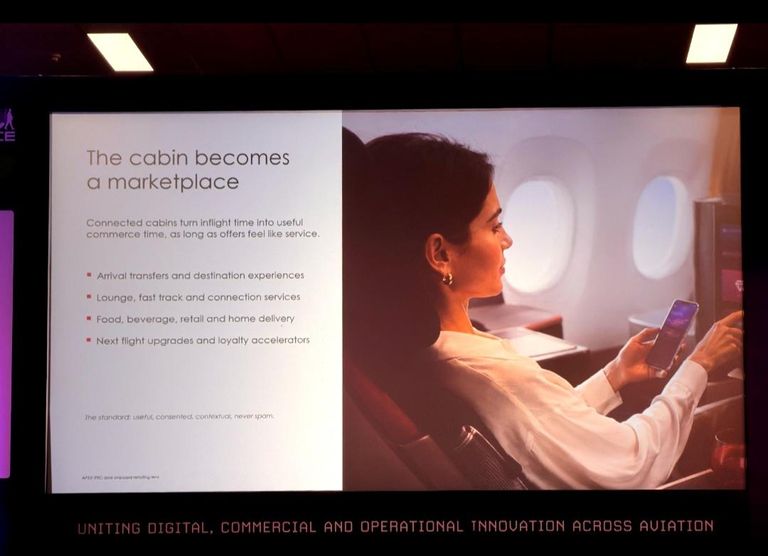
Finnair’s experience is a prime example: passengers can order food and drinks directly from their smartphones during the flight. The addition of Apple Pay has made the purchasing process much simpler and helped increase the number of such orders.
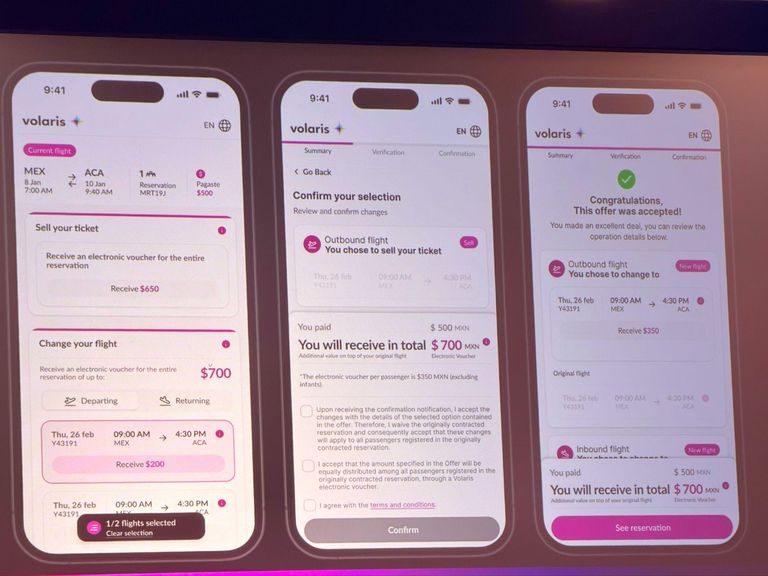
Another interesting example is Volaris, which allows for the resale of vacant seats on flights. According to data cited in the article, such seats can be sold for approximately 2.5 times the original fare, and this model already accounts for about 1.9% of the airline’s total revenue.
The main point of the article is simple: additional revenue can often be generated not by creating a new product, but by making the purchase process as simple as possible for the passenger.
Full version: “The Money Is No Longer in the Ticket” — Aviaedge:
https://www.aviaedge.com/.../the-money-has-left-the-ticket
“Now the Machine Makes the Choice”
Artificial intelligence is gradually changing the way passengers search for and purchase air travel services. Instead of comparing dozens of options on their own, AI agents can handle part of this work.
One example presented at the conference was an AI agent that sent 881,776 fare inquiries to Etihad’s system in a single day. None of these resulted in a booking, but the sheer number of inquiries illustrates the scale of this new interaction between artificial intelligence and aviation platforms.
For airlines, this means that their fares, rules, and services must be understandable not only to passengers but also to automated systems.
At the same time, questions of liability arise. A telling example was the Air Canada case, in which a chatbot provided a passenger with incorrect fare information, and the airline was held liable for the actions of its own system.
Full version: “Now the Machine Chooses” — Aviaedge:
https://www.aviaedge.com/.../the-intelligence-has-moved...
“The Store That Airports Don’t Build”
This third article explores new opportunities for airports to increase non-aviation revenue.
Traditionally, this has required expanding stores, restaurants, and other physical infrastructure. Digital platforms make it possible to change this approach.
For example, Interlinked creates digital marketplaces for airports under their own brands. Passengers can purchase goods online, even if they aren’t physically available in the terminal. The catalog on such platforms can include around 25,000 brands.
Another example is Grab, which allows passengers to order food from their smartphones and pick it up near the boarding gate. According to data cited in the article, the platform has already processed over 45 million transactions.
Digitalization opens up opportunities for airports to generate revenue from additional services without the need for large-scale construction or the expansion of retail space.
Full version: “The Store the Airport Doesn’t Build” — Aviaedge:
https://www.aviaedge.com/.../the-shop-the-airport-never...
These three articles highlight a common trend: the aviation industry is becoming more digital, flexible, and focused on new revenue streams.
For the Ukrainian aviation industry, these approaches may be particularly relevant as it moves toward recovery. International experience allows us to evaluate, even today, new models and solutions that could be applied at Ukrainian airports and airlines.
We recommend reading the full versions of these articles on the Aviaedge website—they contain more interesting examples, practical case studies, and insights from the APEX FTE EMEA and Ancillary & Retailing 2026 conferences.